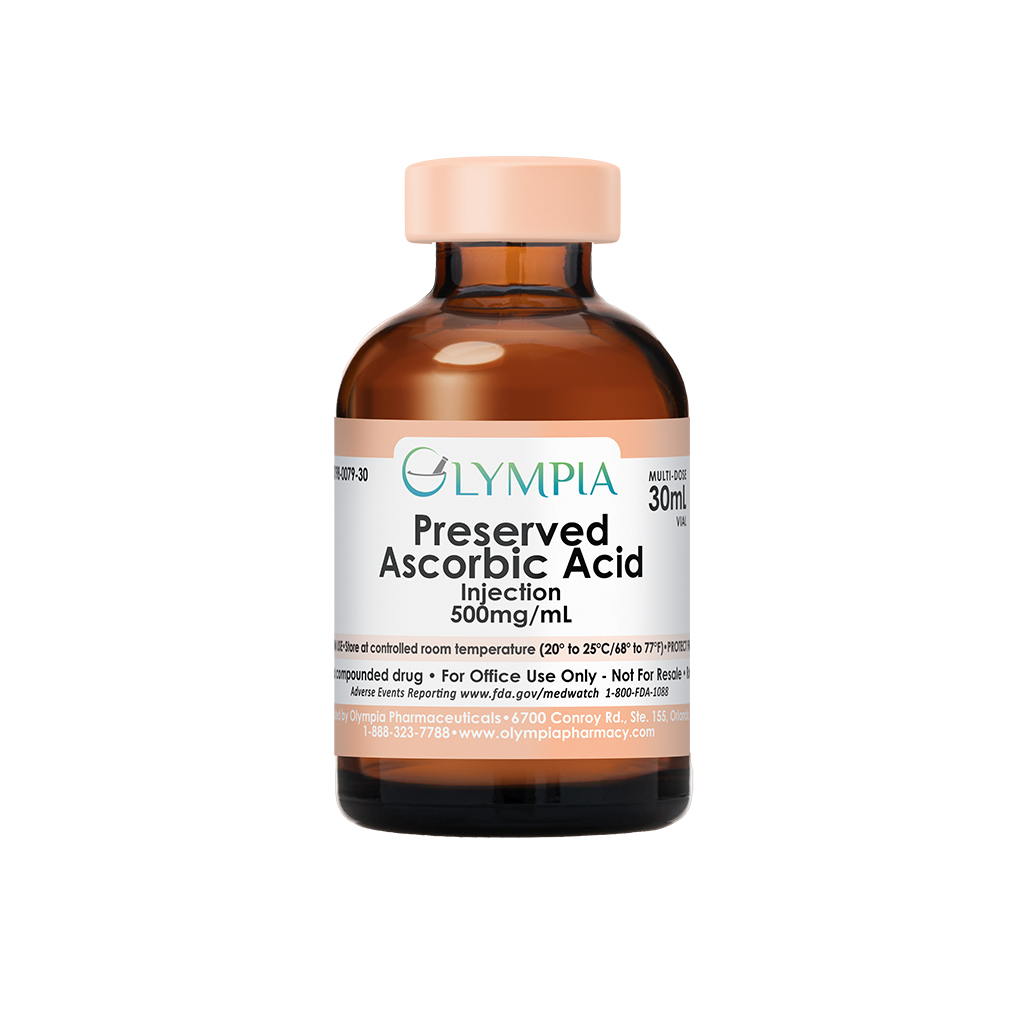
Vitamin C ingredient reference—not a confirmed program kit.
Olympia pharmacy reference
Olympia Ascorbic Acid — Ingredient Reference
Vitamin C ingredient reference—not a confirmed program kit.
This information is for educational purposes only, and not intended to substitute nor replace information from a medical provider. Compounded products are not evaluated by the FDA for safety, efficacy, or quality. Consult your medical provider before beginning any new form of care. Rx Only. Individual results vary.
A coordinated conversation
High-Dose Vitamin C IV Infusion
High-Dose Vitamin C IV Infusion is presented as complementary and integrative support alongside oncology care. Any consideration of this service should be coordinated with the patient’s treating oncology team and the Stronger Every Day provider.
This service is not a cure for cancer or a treatment for cancer. It is not a replacement for radiation, chemotherapy, or another treatment plan recommended by a treating clinician.
Pharmacologic IV vitamin C is an off-label therapy and is not FDA-approved as a cancer treatment. Discuss this option with your oncology and healthcare providers. Individual results vary.
Discuss your complete health history, current oncology care, medicines, supplements, and questions with the clinicians involved in your care. No specific benefit or outcome is promised.
Keep the information handy
High-Dose IV Vitamin C Patient Education
Download our original patient-education document for preparation, monitoring, aftercare, research context and important safety disclaimers. Discuss it with your oncology and healthcare providers before considering treatment.
These practical notes are intended to help you prepare for a pharmacologic vitamin C IV support visit. Follow the individualized instructions provided by your healthcare team.
Hydrate, unless you have fluid restrictions
Drink plenty of water before your appointment and throughout the day, unless your healthcare provider has given you fluid restrictions.
Eat and bring a snack
Eat a meal or snack before your appointment. Bring a snack for during or after your infusion. Good choices include fruit, yogurt, cheese, nuts or seeds, or a balanced snack with protein and carbohydrates.
Include calcium-rich foods
Make calcium-rich foods a regular part of your diet during your IV vitamin C program.
Milk or calcium-fortified milk alternatives
Greek yogurt, yogurt, cheese, or cottage cheese
Kale, bok choy, and collard greens
Canned salmon or sardines with bones
Calcium-set tofu
Food-first nutrition is preferred. Do not begin calcium supplements unless your healthcare provider recommends them.
Wear comfortable clothing
Wear loose, comfortable clothing that allows easy access to your arm for the IV. Bring a sweater or light layer if you tend to get cold.
Create a calm environment
Your infusion is a time to slow down and rest. You may bring headphones, music, a book, tablet, blanket, or journal. You may also bring a support person if you would like.
During your infusion
Your nurse will monitor you throughout treatment.
You may experience temporary:
Warmth or flushing
Mild nausea
Headache
Lightheadedness or dizziness
Tiredness or weakness
Blood-pressure changes
IV-site discomfort
After your infusion
What to expect during the first 24 hours
Some effects may be temporary. They should generally be mild and temporary; contact your healthcare provider if symptoms are severe, persistent, unusual, or worsening.
Temporary symptoms you may notice
Fatigue or an increased need for rest
Mild headache
Nausea or stomach discomfort
Feeling warm or flushed
Lightheadedness
General weakness
Increased thirst
Hydrate within your restrictions
Continue drinking plenty of water after your infusion unless you have been instructed to restrict fluids. Good hydration supports normal kidney function and fluid balance.
Keep calcium-rich foods in your routine
Continue including calcium-rich foods throughout your treatment program and follow any individualized dietary or calcium recommendations from your healthcare provider.
Milk or calcium-fortified milk alternatives
Greek yogurt, yogurt, cheese, or cottage cheese
Kale, bok choy, and collard greens
Canned salmon or sardines with bones
Calcium-set tofu
Understanding high-dose IV vitamin C
Why IV vitamin C is different from oral vitamin C
Vitamin C is an essential nutrient that plays important roles throughout the body. Oral
vitamin C is limited by intestinal absorption, while intravenous vitamin C can achieve
blood concentrations substantially higher than those possible with oral supplementation.
At pharmacologic doses, vitamin C may act differently than it does at nutritional doses.
With oral vitamin C, intestinal absorption becomes limited as the dose increases. IV
administration bypasses this limitation and allows vitamin C to reach pharmacologic blood concentrations.
This is why high-dose IV vitamin C is different from simply taking a large amount of vitamin C by mouth.
What research is investigating
Possible mechanisms at pharmacologic concentrations
When vitamin C is given intravenously at high doses, blood levels can become much higher
than with oral vitamin C. Research has explored several possible biologic effects; these
mechanisms are not a promise of efficacy or a proven cancer treatment.
Possible oxidative stress around cancer cells
Under certain conditions, high concentrations of vitamin C can generate hydrogen peroxide
in the extracellular environment. Cancer cells may have less ability than normal cells to
manage this oxidative stress, making them a potential target of pharmacologic vitamin C.
This is a proposed mechanism under investigation, not proof that IV vitamin C treats cancer.
Possible effects on cancer-cell metabolism
Research suggests that pharmacologic vitamin C may affect cellular energy metabolism and pathways involved in cancer-cell survival. These effects appear to vary depending on the type and biology of the cancer.
Laboratory and early clinical research does not establish a guaranteed response.
Support for normal cellular functions
Vitamin C is required for collagen production, wound healing, immune-system function, neurotransmitter production, antioxidant protection, and normal connective-tissue health.
Potential supportive benefits
What people with cancer have reported in research
Research investigating pharmacologic IV vitamin C in people with cancer has reported possible supportive benefits. Individual responses vary, and research results are not uniform.
Quality of life
Some clinical studies have reported improvements in quality-of-life measures and general well-being.
Fatigue and energy
Some patients report improved energy or reduced fatigue, although individual responses vary and research results are not uniform.
Treatment-related symptoms
Some studies have reported reductions in symptoms or treatment-related side effects when IV vitamin C is used alongside conventional cancer treatment.
Support during cancer care
Vitamin C supports normal immunity, connective tissue, and antioxidant functions and may provide nutritional support during a physically demanding period.
Potential anti-cancer effects
Laboratory and early clinical research suggest that pharmacologic vitamin C may have direct effects on certain cancer cells. IV vitamin C has not been established as a stand-alone cancer treatment.
Your oncology care
Coordinate every part of your treatment plan.
Pharmacologic IV vitamin C is intended as complementary or supportive care. It should be used in coordination with your oncology team.
IV vitamin C does not replace recommended care
Chemotherapy
Immunotherapy
Radiation
Surgery
Hormonal therapy
Targeted therapy
Other evidence-based cancer treatment
Research continues to investigate which cancer types, treatment combinations, and patients may benefit most.
Individualized, provider-managed dosing
Your plan is based on your response and tolerance.
At Stronger Every Day, treatment may begin with a three-step Riordan-informed titration approach: 15 g → 25 g → 50 g.
This sequence is a provider-managed clinical dosing example only—not a patient instruction or recommendation. Do not self-administer IV vitamin C or change a dose based on this educational page.
Post-infusion plasma vitamin C testing may be used to evaluate your individual response and
help guide future dosing. Individual patients may require different doses to reach a similar
blood level, and a specific dose does not guarantee a therapeutic blood concentration.
Your care. Your team. Your journey.
Supportive care should address the whole person.
At Stronger Every Day, we believe supportive care should address the whole person—soul, mind, and body. Our goal is to provide thoughtful, evidence-informed support while working alongside your medical and oncology team.
Rest. Hydrate. Nourish your body. Give yourself permission to slow down. We are here to support you throughout your journey.
Patient education references
References
Our patient-education document includes the following research references.
Carr, A. C., & Cook, J. (2018). Intravenous vitamin C for cancer therapy—Identifying the current gaps in our knowledge. Frontiers in Physiology, 9, 1182.
https://doi.org/10.3389/fphys.2018.01182
Nauman, G., Gray, J., Parkinson, R., Levine, M., & Paller, C. J. (2018). Systematic review of intravenous ascorbate in cancer clinical trials. Antioxidants, 7(7), 89.
https://doi.org/10.3390/antiox7070089
Schoenfeld, J. D., Sibenaller, Z. A., & Tan, M. (2021). High-dose intravenous vitamin C, a promising multi-targeting agent in the treatment of cancer. Frontiers in Oncology, 11, 679519.
https://doi.org/10.3389/fonc.2021.679519
Fritz, H., Flower, G., Weeks, L., et al. (2014). Intravenous vitamin C and cancer: A systematic review. Integrative Cancer Therapies, 13(4), 280–300.
https://doi.org/10.1177/1534735414534463
Hoffer, L. J., Levine, M., Assouline, S., et al. (2008). Phase I clinical trial of i.v. ascorbic acid in advanced malignancy. Annals of Oncology, 19(11), 1969–1974.
https://doi.org/10.1093/annonc/mdn377
About the pharmacy product
Olympia Ascorbic Acid — Ingredient Reference
The image shows Olympia’s preserved ascorbic-acid injectable product. It illustrates vitamin C product information, not an assumed program kit or the exact product dispensed for your visit. Your provider determines the appropriate formulation, eligibility and clinical dose.
The photographed pharmacy product and vial information identify the source ingredients. Your clinician determines the final infusion formulation and dose; vial concentrations and kit volumes are not individual dosing instructions.
This information is for educational purposes only, and not intended to substitute nor replace information from a medical provider. Compounded products are not evaluated by the FDA for safety, efficacy, or quality. Consult your medical provider before beginning any new form of care. Rx Only. Individual results vary.